godot-game-skills

Practical agent skills for building, debugging, and verifying Godot games.
Review the source code before installing. Scripts can execute arbitrary commands on your system.
Opens Skill Vault Desktop and installs in one click. Don't have it yet? Get the app →
sv install themarco/godot-game-skills
Requires the sv CLI. Installs to ~/.claude/skills/godot-game-skills/.
.cursor/skills/godot-game-skills/SKILL.md
Download and place the SKILL.md file into your .cursor/skills/godot-game-skills/ directory.
sv install themarco/godot-game-skills --target codex
Installs to ~/.codex/skills/godot-game-skills/. Requires the sv CLI.
curl -sL https://skillvault.md/api/packages/themarco/godot-game-skills/download -o godot-game-skills.zip
Downloads the package as a zip archive to your current directory.
https://skillvault.md/api/packages/themarco/godot-game-skills/download
Download the zip, extract, and copy the relevant files into your project.
Godot Game Skills
Practical agent skills for building, debugging, and verifying Godot games.
Eight focused skills turn production lessons from a procedural 3D game into reusable workflows: stable generation, retained object state, measured performance, reliable checks, authored props, horror pacing, analog presentation and believable wear. Each skill can be installed on its own.
The package includes working tools and a small original Godot project. It needs no paid API, asset service, MCP server or particular model. The most direct fit is Godot 4 with GDScript and 3D scenes. It is an agent-skills pack, not an editor plugin or a complete game framework.
Start here: User handbook for setup, skill selection, step-by-step workflows, tool usage and troubleshooting. Use the prompt cookbook for ready-to-adapt requests covering all eight skills and combined workflows.
The game behind these skills
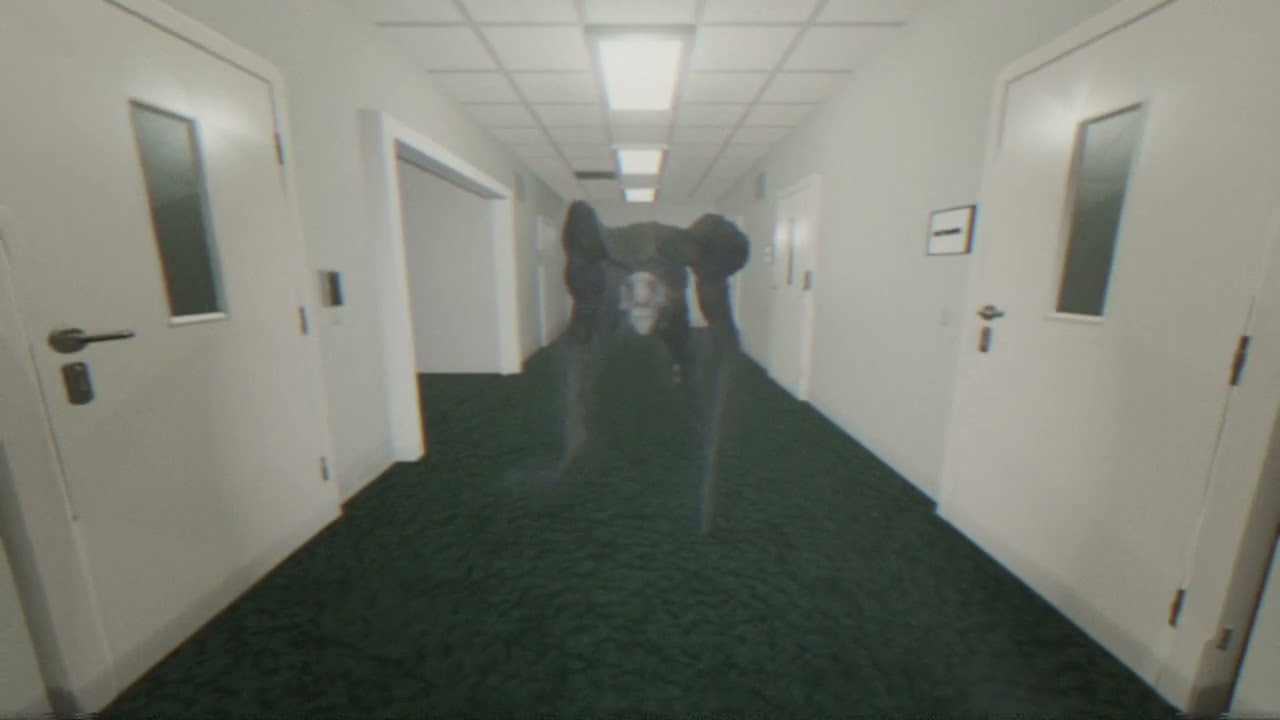
Watch the It Wants You To Stay demo reel on YouTube
These skills grew out of developing It Wants You To Stay, a Godot horror game. As I built the game, I refined workflows for procedural environments, persistent world state, debugging, performance, horror pacing and visual presentation. I extracted those lessons into the eight skills, supporting tools and original examples in this repository so other Godot developers can apply them to their own projects.
Install
Clone the repository and open its directory:
git clone https://github.com/TheMarco/godot-game-skills.git
cd godot-game-skills
Then run from its root with Python 3.10+:
# Inspect changes without installing anything.
python3 scripts/install.py --agent codex --dry-run

# Install all eight skills for one agent.
python3 scripts/install.py --agent codex
python3 scripts/install.py --agent claude

# Or install one skill into an explicit skills directory.
python3 scripts/install.py --dest /path/to/agent/skills --skill godot-procedural-worlds
Codex installation uses $CODEX_HOME/skills when configured, otherwise
~/.codex/skills. Claude installation uses ~/.claude/skills. Use --dest for
other skill-compatible hosts or project-local installation. Avoid installing
duplicate copies into multiple directories discovered by the same agent.
Existing same-named skills are skipped. --force moves each replaced skill to
.godot-game-skills-backups/ inside the destination first; unrelated skills are never
removed. To uninstall, remove only the skill folders you installed. The
installer does not alter agent settings or register background processes.
Use
Open your game project with the agent and request the outcome you want:
Use godot-dev-director to add a procedural warehouse wing. Preserve the existing lighting and saved door states. Verify one representative room before extending the other variants.
For a specific problem, name the specialist directly. In hosts supporting dollar
invocation, use $godot-procedural-worlds, for example. Skills provide workflows;
the host supplies file access, terminal execution and any visual inspection tools.
| Skill | Good first request |
|---|---|
| Development director | Coordinate a change spanning several game systems. |
| Game verification | Reproduce a bug and add a focused check that cannot pass silently. |
| Procedural worlds | Fix shared walls or doors resetting after rooms unload. |
| Performance workflows | Diagnose room-entry hitches while preserving the current look. |
| 3D prop integration | Replace a primitive with a GLB and keep its collision and behavior. |
| Horror pacing | Stop ambient events interrupting encounters and story moments. |
| Analog presentation | Separate camera interference, CRT display and comfort settings. |
| Environment wear | Add stable, cause-based wear that follows its supporting objects. |
The director is optional. Specialists do not require one another or this README after installation. They preserve project-specific art direction, gameplay rules and existing test frameworks.
Try the example
Seeded Room Lab is a nine-cell scene using original box geometry. It demonstrates canonical shared edges, build-order-independent generation, mutable door state surviving rebuilds, and safe rejection of a failed staging attempt.
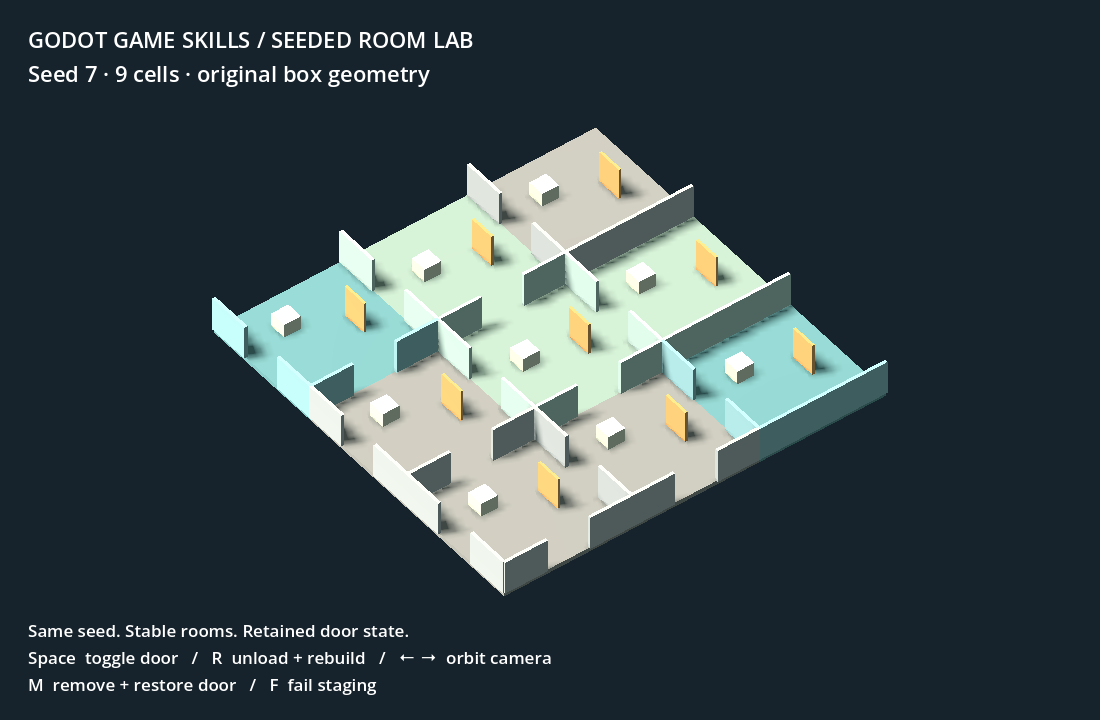
Install an official Godot 4 editor binary and make godot available on PATH, or
pass its executable path with --godot to the runner. From this repository:
godot --path skills/godot-procedural-worlds/assets/seeded-room-lab

python3 skills/godot-game-verification/scripts/run_checks.py \
  --project skills/godot-procedural-worlds/assets/seeded-room-lab \
  --manifest skills/godot-procedural-worlds/assets/seeded-room-lab/checks.json
Space toggles the center door. R unloads and rebuilds rooms. M removes or
restores the door while retaining its state. F rejects a staged replacement.
Arrow keys orbit the camera. This is a contract demonstration, not a player
controller, complete streaming engine or guarantee of navigable generated maps.
Tools you can use without an agent
- Check runner: JSON
manifests, one import pass, bounded processes, explicit success markers, error scanning and separate run reports. A zero exit code alone is insufficient.
compare matched raw samples; report mean, median, p95 and maximum separately. Reject incompatible contexts and retain the distinction between subsystem time and whole-game performance.
deterministic construction, canonical boundaries, state round trips and rejected scene replacements.
Compatibility and evidence
Python helpers use the standard library and require Python 3.10+. Godot examples use Godot 4 GDScript and the Compatibility renderer. Tested environments and remaining gaps are recorded in validation notes. Headless checks do not prove visual quality, renderer compatibility or gameplay feel. Run the relevant rendered/motion check in the consumer's actual game.
To check package changes:
python3 scripts/validate_package.py
python3 -m unittest discover -s tests -v
The CI workflow runs Python validation and helper tests. Godot integration and rendered checks are explicit local steps until additional environments are verified. See contributing for realistic skill evaluations.
Origins and license
Extracted from developing It Wants You To Stay, with original minimal examples and portable helpers. The Three.js Game Skills project inspired the package format. Its code and game assets are not bundled. See extraction notes for what was generalized.
MIT licensed; see LICENSE. No Liminal story, recordings, commercial models, textures, music, credentials or generated import caches are included.
Imported from GitHub: https://github.com/TheMarco/godot-game-skills
No reviews yet. Be the first to review this package.